Category: All

Test Maximizing Operational Performance through Digital Transformation in Manufacturing Industry

The manufacturing industry is at a pivotal moment, with the rise of Industry 4.0 offering unprecedented opportunities to transform operations and drive business growth. As advanced technologies like IoT, AI, robotics, and big data become increasingly integrated into manufacturing processes, companies that adopt these innovations stand to gain a significant competitive edge.

This whitepaper on industry 4.0 and digital transformation serves as a comprehensive guide for manufacturing leaders looking to navigate the complexities of digital transformation. Whether you are aiming to enhance operational efficiency, improve product quality, or reduce costs, Industry 4.0 holds the key to unlocking new levels of performance and profitability.

At Vrinsoft a leading digital transformation company in UK, we specialize in helping manufacturers implement tailored Industry 4.0 strategies that align with their unique business goals. We are at the forefront of digital transformation and helped many manufacturing businesses achieve their peak operational functionalities with our efforts. By leveraging our expertise, you can ensure a smooth transition to smart manufacturing, minimize risks, and maximize return on investment.

Understanding Industry 4.0

Industry 4.0, also known as the Fourth Industrial Revolution, represents the current trend of automation and data exchange in manufacturing technologies. It encompasses a range of advanced technologies that are blurring the lines between the physical and digital worlds, enabling smarter and more efficient production processes. This revolution is driven by the integration of the Internet of Things, cyber-physical systems, advanced data analytics, and artificial intelligence, which collectively transform traditional manufacturing practices into interconnected, intelligent ecosystems.

Key Concepts and Technologies

Industry 4.0 is underpinned by several key concepts and technologies that differentiate it from previous industrial revolutions. These include the convergence of digital and physical systems, real-time data analytics, and the use of artificial intelligence to optimize production. Unlike the earlier revolutions, which focused on mechanization, mass production, and automation, Industry 4.0 emphasizes connectivity, flexibility, and personalized production.

Cyber-Physical Systems: Integration of physical processes with digital networks, enabling real-time monitoring and control.

Internet of Things: Network of interconnected devices that collect and exchange data, facilitating smarter decision-making.

Big Data and Advanced Analytics: Analysis of vast amounts of data to uncover insights, optimize processes, and predict trends.

Artificial Intelligence and Machine Learning: Use of algorithms and learning systems to enhance automation and decision-making.

Cloud Computing: Utilization of cloud-based platforms to store and process data, enabling scalability and flexibility.

Additive Manufacturing: Advanced 3D printing technologies that allow for customized production and rapid prototyping.

Evolution from Previous Industrial Revolutions

Industry 4.0 is a natural progression from previous industrial revolutions, each of which introduced transformative changes to manufacturing. The first revolution brought about mechanization through water and steam power, the second introduced mass production with electricity, and the third revolution focused on automation using computers and electronics. Industry 4.0 builds upon these advancements by integrating digital technologies with physical processes, leading to more agile, efficient, and customizable manufacturing systems.

Benefits and Objectives of Industry 4.0

The primary objectives of Industry 4.0 are to enhance productivity, reduce costs, and increase flexibility in manufacturing. By adopting these advanced technologies, manufacturers can achieve significant improvements in efficiency, product quality, and time-to-market. Additionally, Industry 4.0 aims to create more sustainable production methods by optimizing resource usage and minimizing waste.

Key Benefits of Industry 4.0

Increased Efficiency: Streamlined operations and reduced downtime through predictive maintenance and real-time monitoring.

Enhanced Product Quality: Continuous quality control and optimization enabled by data-driven insights.

Greater Flexibility: Ability to quickly adapt to changes in demand and customize products to meet specific customer needs.

Cost Reduction: Lower operational costs due to automation, energy efficiency, and optimized resource management.

Sustainability: Reduced environmental impact through efficient use of resources and energy.

Assessing Readiness for Digital Transformation

It’s crucial for manufacturing businesses to assess their current readiness before implementing digital transformation. This involves a comprehensive evaluation of existing processes, technologies, and organizational culture to determine how well-equipped the business is to adopt new digital tools and methodologies. Understanding where the company stands in terms of digital maturity helps in setting realistic goals and developing a tailored transformation strategy.

Evaluating Current Manufacturing Processes

Before starting the readiness assessment, it’s important to thoroughly evaluate the current manufacturing processes. This means mapping out all key operations, identifying which processes are manual, semi-automated, or fully automated, and analysing the efficiency of each. Look for bottlenecks, inefficiencies, and areas where data is underutilized. This evaluation will help you understand the gaps that digital transformation can fill.

Key Aspects to Evaluate:

  • Process Automation Levels

One of the first things businesses need to evaluate is the automation across different manufacturing processes. It will help them identify which areas still depend on manual labour and which are already automated. Once you learn about this, you can pinpoint the process that digital transformation can automate and improve to reduce errors. This also brings new opportunities to integrate new and advanced technology to the manufacturing floor to enhance productivity.

  • Data Utilization

Assessing how data is currently collected, processed, and used for decision-making is crucial for fully benefiting from digital transformation. This evaluation should include analysing where the data comes from, how it’s processed, and how it’s used to make decisions. Finding any gaps or inefficiencies in data use can uncover opportunities to use advanced analytics and real-time monitoring tools.

  • Technology Infrastructure

Reviewing your current technology systems and their ability to work with new tools is an important step in the digital transformation process. You need to see if your current hardware and software can work with Industry 4.0 technologies like IoT, cloud computing, and automation systems. Knowing the strengths and weaknesses of your technology infrastructure can help you plan any upgrades or changes you might need to make to support smooth integration and growth.

  • Workflow Efficiency

Identifying slow or redundant processes that could benefit from digital optimization is key to enhancing overall operational efficiency. This involves mapping out existing workflows, analysing the flow of materials and information, and pinpointing areas where delays or bottlenecks occur. By recognizing inefficiencies, you can prioritize digital initiatives that streamline processes, reduce waste, and accelerate production cycles.

  • Quality Control

Assessing the effectiveness of current quality assurance processes and their potential for improvement through digital tools is essential for maintaining high standards in manufacturing. This evaluation should consider the methods used for monitoring and controlling product quality, the frequency of defects, and the responsiveness of quality control measures. Implementing digital solutions like real-time quality monitoring, predictive analytics, and automated inspection systems can significantly enhance the accuracy and consistency of quality control efforts.

Identifying Strengths and Weaknesses

Once the current processes are evaluated, the next step is to identify the strengths and weaknesses within the organization. Understanding these elements is critical for leveraging existing advantages while addressing areas of improvement.
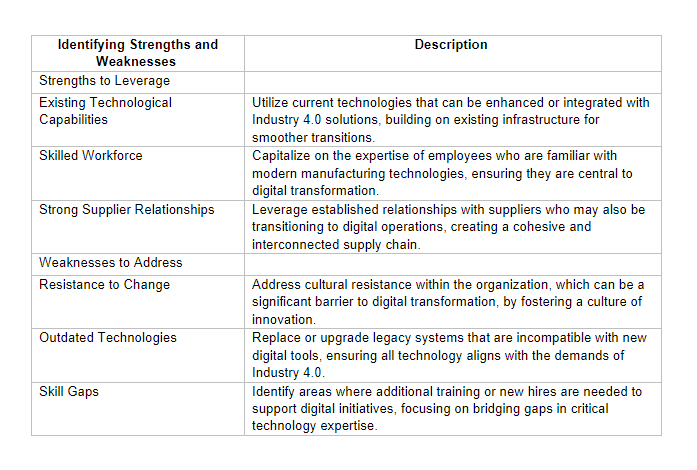
Identifying Strengths and Weaknesses

Setting Transformation Goals

After identifying the strengths and weaknesses, it’s essential to set clear and achievable transformation goals. These goals should align with the overall business strategy and be specific, measurable, attainable, relevant, and time-bound (SMART). Setting the right goals ensures that the digital transformation journey is focused and delivers tangible results.

Examples of Transformation Goals

  • Increase Automation by X%: Aim to automate specific processes that are currently manual to improve efficiency.
  • Enhance Data Analytics Capabilities: Implement advanced analytics tools to better utilize data for decision-making.
  • Reduce Production Costs by Y%: Use digital technologies to streamline operations and reduce waste, leading to cost savings.
  • Improve Product Quality: Set targets for reducing defects and improving consistency through better process control.
  • Expand Digital Skills in the Workforce: Develop training programs to equip employees with the necessary skills for working with new technologies.

By carefully evaluating readiness, identifying strengths and weaknesses, and setting clear goals, manufacturing businesses can create a solid foundation for successful digital transformation.

Developing a Digital Transformation Strategy

Creating a comprehensive digital transformation strategy is essential for manufacturing businesses aiming to stay competitive in the industry 4.0 era. This strategy should be a well-structured plan that aligns the company’s vision with actionable steps, ensuring that digital initiatives drive meaningful improvements. Here are some of the essential steps that can help your manufacturing business create a digital transformation strategy,

Defining Vision and Objectives

When creating a digital transformation strategy, start by clearly stating the vision and objectives. The vision should describe where the company wants to be in the future, reflecting the long-term goals of the digital transformation. This vision will guide all future actions and decisions, ensuring that every initiative aligns with the overall strategic direction.

Key Considerations for Defining Vision

  • Establish what the company wants to achieve in 5, 10, or 20 years with digital transformation.
  • Define how the company plans to differentiate itself from competitors through technology.
  • Ensure the vision includes how digital transformation will enhance customer satisfaction and experience.
  • Incorporate goals related to sustainable practices and continuous innovation in manufacturing.

Once the vision is clear, specific objectives must be set to make that vision a reality. These objectives should be practical, measurable, and focused on areas that will have the most significant impact on the business.

Examples of Strategic Objectives

  • Aim to reduce production time and costs through automation and data-driven decision-making.
  • Use digital tools to monitor and control quality in real time, reducing defects and variability.
  • Enable customization and agile manufacturing processes to respond quickly to market demands.

Creating a Roadmap for Implementation

After defining the vision and objectives, the next step is to create a roadmap that outlines the specific steps and milestones needed to achieve them. This roadmap should detail the sequence of initiatives, allocate resources, and set timelines for each phase of the transformation.

Components of an Effective Roadmap

  • Phased Approach: Break down the transformation into manageable phases, starting with high-impact areas.
  • Resource Allocation: Identify the necessary resources, including budget, technology, and personnel, for each phase.
  • Timelines and Milestones: Set realistic timelines and milestones to track progress and maintain momentum.
  • Risk Management: Include a risk assessment to anticipate potential challenges and plan for contingencies.
  • Stakeholder Involvement: Ensure that key stakeholders are involved in the planning and execution to secure buy-in and support.

Once you create an effective roadmap for digital transformation for your manufacturing business, the implementation process is straightforward. Here is an example of how we can use various phrases for a successful implementation,

  • Conduct a thorough evaluation of current processes and define the digital strategy.
  • Implement small-scale pilot projects to test new technologies and approaches.
  • Expand successful pilots to other areas of the business, integrating more systems and processes.
  • Achieve full-scale implementation, ensuring all technologies are aligned and working together.
  • Regularly review and refine the digital strategy based on feedback and changing market conditions.

Aligning Technology with Your Manufacturing Business

One of the most critical aspects of a digital transformation strategy in the manufacturing industry is ensuring that the chosen technologies align with the specific needs and goals of the business. Technology should not be adopted for its own sake but selected based on how well it can support the company’s objectives, enhance production efficiency, and improve overall operations. In manufacturing, this alignment is key to driving innovation, reducing costs, and maintaining a competitive edge.

Steps to Align Technology with Manufacturing Needs

  • Needs Assessment

Start with a comprehensive assessment of the manufacturing operation’s strategic and operational needs. Identify critical areas such as production efficiency, quality control, supply chain management, and equipment maintenance where technology can provide the most value.

  • Technology Evaluation

Evaluate various technologies, such as IoT, robotics, AI, and advanced analytics, based on their ability to address the identified needs. Consider factors like scalability to accommodate production growth, integration capabilities with existing manufacturing systems, and overall cost-effectiveness.

  • Customization

Select technologies that can be customized to fit the specific requirements of your manufacturing processes. Ensure that the chosen solutions seamlessly integrate with existing workflows and equipment, enhancing rather than disrupting current operations.

  • Digital Transformation Company

Choose a reliable digital transformation partner who understands the unique demands of the manufacturing industry. Go for partners who not only offer the right technology but also provide strong ongoing support, training, and the ability to scale the solutions as your manufacturing needs evolve.

  • Future-Proofing

Consider the future trajectory of your manufacturing business and the industry at large. Select technologies that can evolve alongside your company, supporting innovations such as additive manufacturing, smart factories, and sustainable production practices as they become more prevalent.

Key Technologies in Industry 4.0

Industry 4.0 is powered by a suite of cutting-edge technologies that transform traditional manufacturing processes into smart, interconnected systems. These technologies enable real-time data collection, advanced analytics, and automation, driving efficiency and innovation. By integrating these technologies, manufacturers can enhance productivity, reduce costs, and create more agile and responsive production environments.

  • Internet of Things

Modern manufacturing units can take advantage of IoT technology as it can connect physical devices across the manufacturing floors to communicate and share data in real-time. This connectivity allows for continuous monitoring and optimization of processes, leading to improved efficiency and reduced downtime. IoT also facilitates predictive maintenance, helping prevent equipment failures and extending the lifespan of machinery.

Siemens has integrated IoT in their smart factory solutions, using sensors and connected devices to monitor equipment health and predict maintenance needs. This approach reduces downtime and enhances operational efficiency by addressing issues before they become critical.

  • Advanced-Data Analytics and Big Data

Manufacturers can use Advanced Data Analytics and Big Data to analyze the large amount of data collected from IoT devices and other sources. This helps companies gain deep insights into their operations, spot trends, and make decisions based on data. These tools improve everything from quality control to supply chain management, making operations more informed and efficient.

General Electric (GE) utilizes big data and advanced analytics through its Predix platform to monitor and optimize industrial operations. The platform processes vast amounts of data from sensors to enhance performance and predict equipment failures across their manufacturing plants.

  • Artificial Intelligence and Machine Learning

AI and machine learning are important for smart manufacturing in Industry 4.0. These technologies help systems learn from data, make better decisions, and automate complex tasks. AI-based analytics can predict demand, optimize production schedules, and improve quality control. Meanwhile, machine learning algorithms continuously improve processes for greater efficiency and accuracy.

BMW has implemented AI in its quality control processes. AI-driven image recognition systems help detect defects in components on the production line, significantly improving product quality and reducing waste.

  • Robotics and Automation

These technologies are central to achieving high levels of precision, speed, and efficiency in manufacturing. Automated robots can perform repetitive tasks with consistent accuracy, reducing human error and freeing up workers for more strategic roles. These systems also enable flexible manufacturing, allowing for rapid reconfiguration of production lines to meet changing demands.

Fanuc uses robotics in its production lines, where automated systems handle repetitive tasks with high precision. This automation not only increases productivity but also allows human workers to focus on more complex and creative tasks.

  • Cyber-Physical Systems and Digital Twins

CPS and Digital Twins bridge the gap between the physical and digital worlds in manufacturing. CPS integrates physical processes with digital control systems, enabling real-time monitoring and optimization. Digital Twins, on the other hand, are virtual replicas of physical assets, allowing manufacturers to simulate and optimize processes before implementing changes, reducing risk and enhancing efficiency.

Rolls-Royce leverages digital twin technology to create virtual models of their jet engines. These digital twins simulate real-world operations, enabling the company to monitor performance, predict maintenance needs, and optimize engine design.

Practical Steps for Implementation

Successfully implementing Industry 4.0 technologies in manufacturing requires a strategic approach that balances innovation with practicality. The following steps outline how manufacturers can effectively integrate IoT and smart devices, leverage data for better decision-making, automated processes, and ensure robust cybersecurity and data privacy. These steps serve as a guide to navigating the complexities of digital transformation while maximizing benefits and minimizing risks.

Integrating IoT and Smart Devices

Integrating IoT and smart devices is the foundation of any Industry 4.0 strategy. To start, manufacturers should identify key areas where IoT can deliver the most value, such as monitoring machine performance, tracking inventory, or optimizing energy usage. The next step is to select and deploy IoT devices that can seamlessly integrate with existing systems. It’s important to establish a reliable network infrastructure to ensure these devices can communicate effectively.

Once in place, the focus should be on data collection and analysis, enabling real-time monitoring and proactive maintenance. Pilot projects can be useful to test and refine IoT applications before full-scale deployment.

Key Actions

  • Identify high-impact areas for IoT deployment.
  • Select and integrate IoT devices with existing systems.
  • Ensure robust network infrastructure for device communication.
  • Use pilot projects to refine IoT applications.

Leveraging Data for Decision-Making

Data is the new currency in Industry 4.0, and leveraging it effectively is crucial for informed decision-making. To make the most of data, manufacturers should first establish a centralized data platform where information from IoT devices and other sources is aggregated. Advanced analytics tools can then be applied to this data to uncover actionable insights.

For instance, predictive analytics can forecast demand, optimize production schedules, and reduce waste. It’s also essential to train teams on data literacy to ensure they can interpret and act on insights effectively. Regular reviews of data-driven decisions help refine strategies and improve outcomes over time.

Key Actions

  • Establish a centralized data platform.
  • Apply advanced analytics for actionable insights.
  • Train teams on data literacy and interpretation.
  • Regularly review and refine data-driven strategies.

Automating Processes and Systems

Automation is a cornerstone of Industry 4.0, enabling manufacturers to increase efficiency, reduce errors, and scale operations. To begin automating processes, companies should identify repetitive, time-consuming tasks that can benefit from automation. Robotics and AI-powered systems can be implemented to handle these tasks, allowing for greater precision and speed. Integrating automation with IoT devices ensures real-time data feeds into automated systems, further enhancing their effectiveness.

It’s crucial to start with small-scale automation projects to prove value and learn from the experience before scaling up. Additionally, continuous monitoring and optimization of automated processes are essential to maintain efficiency and adapt to changing needs.

Key Actions

  • Identify tasks suitable for automation.
  • Deploy robotics and AI-powered systems.
  • Integrate automation with IoT for real-time data input.
  • Start with small-scale projects, then scale up.
  • Continuously monitor and optimize automated processes.

Ensuring Cybersecurity and Data Privacy

As manufacturing systems become increasingly interconnected, ensuring cybersecurity and data privacy becomes paramount. The first step is to conduct a comprehensive risk assessment to identify potential vulnerabilities across the digital landscape. Manufacturers should then implement multi-layered security measures, including encryption, firewalls, and intrusion detection systems, to protect sensitive data and prevent unauthorized access.

Regular updates and patches to software and hardware are critical to maintaining security over time. In addition, developing a robust incident response plan ensures that the organization is prepared to respond quickly and effectively in case of a breach. Educating employees about cybersecurity best practices and fostering a culture of vigilance is equally important in safeguarding the entire operation.

Key Actions

  • Conduct a comprehensive cybersecurity risk assessment.
  • Implement multi-layered security measures (encryption, firewalls, etc.).
  • Regularly update software and hardware.
  • Develop and maintain an incident response plan.
  • Educate employees on cybersecurity best practices.

Managing Change and Overcoming Challenges

  • Addressing Organizational Resistance

Overcoming resistance in manufacturing involves engaging workers early, demonstrating how new technologies will improve efficiency, and fostering a culture that supports innovation and digital adoption.

  • Training and Upgrading Skills

Provide targeted training programs to ensure that your manufacturing workforce is skilled in using advanced machinery and digital tools, crucial for maintaining productivity and competitiveness.

  • Managing Costs and Resources

In manufacturing, prioritize investments in technologies that offer the highest return on investment while managing resources efficiently to support sustainable digital transformation.

  • Ensuring Smooth Integration and System Compatibility

Ensure new digital systems integrate smoothly with existing manufacturing equipment and processes, minimizing downtime and maximizing production efficiency across the facility.

  • Measuring Success and ROI

Measuring the success of Industry 4.0 initiatives in the manufacturing sector requires a systematic approach to assess the impact of digital transformation efforts. Understanding the return on investment is crucial for evaluating the effectiveness of implemented technologies and strategies.

Key Performance Indicators

To effectively measure success, organizations should establish Key Performance Indicators that align with their transformation goals. Common KPIs for Industry 4.0 include,

Operational Efficiency: Metrics such as production cycle time, machine uptime, and energy consumption can help gauge improvements in efficiency.

Product Quality: Defect rates, yield rates, and customer satisfaction levels provide insight into the quality enhancements achieved through automation and data-driven decision-making.

Cost Reduction: KPIs like cost per unit, inventory turnover, and waste reduction measure the financial impact of digital initiatives.

Employee Productivity: Labor efficiency, output per employee, and the impact of automation on workforce productivity are key indicators of success.

Time to Market: The time taken to develop and deliver new products is crucial for assessing the agility of the manufacturing process.

Tracking Progress and Performance

Once KPIs are established, continuous tracking is essential to ensure that the digital transformation initiatives are on the right path. Real-time data collection and analytics platforms play a significant role in monitoring performance. Dashboards can be used to visualize progress, making it easier for decision-makers to identify trends, areas of improvement, and any deviations from expected outcomes.

Regular reviews and reports should be scheduled to assess whether the transformation is achieving its intended objectives. By comparing actual performance against the set KPIs, organizations can determine the effectiveness of their strategies and make informed decisions on further steps.

Adjusting Strategies Based on Feedback

Digital transformation is an ongoing process, and flexibility is key to its success. As the implementation progresses, feedback from the KPIs and other monitoring tools should be used to refine strategies. This could involve:

Revisiting Goals: If certain goals are not being met, it may be necessary to adjust them to better align with realistic outcomes or evolving business needs.

Optimizing Processes: Continuous improvement should be a focus, with regular tweaks to processes based on performance data.

Adapting to New Technologies: As technology evolves, the strategy may need to incorporate new tools and techniques to maintain competitiveness.

Resource Reallocation: Resources might need to be redistributed to areas showing the most potential for improvement or to address any unforeseen challenges.

Conclusion

As the manufacturing industry continues to evolve, adopting Industry 4.0 is no longer just an option; it’s a necessity for staying competitive. The integration of smart technologies into your operations can significantly boost efficiency, reduce costs, and open new avenues for growth. However, the journey toward digital transformation requires careful planning, strategic execution, and ongoing adaptation.

Partnering with experts who understand the unique challenges and opportunities of Industry 4.0 can make all the difference in ensuring a successful transformation. At Vrinsoft, we are committed to guiding manufacturers through every step of this process, from strategy development to technology implementation and beyond.

By taking decisive action now, you can position your business to thrive in the new era of manufacturing. Let Vrinsoft be your trusted partner in navigating this transformation, driving innovation, and achieving sustainable success. Reach out to us today to learn how we can help you harness the full potential of Industry 4.0.

Maximizing Operational Performance through Digital Transformation in Manufacturing Industry

In the manufacturing industry, optimizing production processes is essential to remain at the forefront. Digital transformation emerges as a key strategy to enhance operational performance, offering manufacturers the opportunity to leverage modern technologies for optimizing processes and reducing costs. As the industry evolves, understanding how to effectively integrate digital tools and strategies becomes essential for achieving operational excellence.

In this post, we have provided detailed information on why the manufacturing industry needs to upgrade and what the challenges are. We also added which technology to utilize for digital transformation adoption in manufacturing sectors and how to implement it. Digital transformation companies offer advanced solutions to the manufacturing industry, enabling them to optimize operational workflows, implement cost-effective strategies, and maintain a competitive edge in the demanding contemporary market.

The Need for Digital Transformation

The manufacturing industry worldwide faces a wide range of challenges that require a thorough change from traditional methods. Evolving customer expectations and demand for faster, more convenient production cycles are just some of the issues. For example, an automotive manufacturer, previously known for its traditional assembly lines, implemented a digital transformation initiative to meet the growing demand for electric vehicles. By adopting advanced technologies like automation and robotics, the company significantly reduce production time and customize vehicles to meet the specific preferences of individual customers.

As businesses try to stay ahead of the competition, digital transformation has become a vital strategy. Research from Deloitte shows that 70% of manufacturers believe that digital transformation will enable them to achieve significant operational efficiencies.

Digital transformation addresses several key areas, including enhanced flexibility, better data utilization, and increased responsiveness to market changes. For manufacturers, this shift means more than just upgrading equipment; it involves overhauling systems, processes, and strategies to leverage digital tools for optimal performance. The World Economic Forum estimates that by 2025, digital transformation could create up to $3.7 trillion in value for manufacturers worldwide, highlighting its critical importance in the industry.

Current Challenges in the Manufacturing Industry

The manufacturing sector is currently grappling with a host of challenges that impact operational efficiency:

  • Supply Chain Disruptions

Global events and complex supply chains have made disruptions more frequent and impactful. Manufacturers need strategies that allow them to adapt quickly to changes and uncertainties.

  • Rising Costs

Increasing costs of raw materials, energy, and labour put pressure on profit margins. Effective cost management is crucial for maintaining financial health.

  • Labour Shortages

There’s a lack of skilled workers in the industry, which is made worse by an ageing workforce and not having enough new talent coming in.

  • Customization Demands

Customers are increasingly seeking personalized products, which requires manufacturers to be more flexible and capable of accommodating bespoke orders without compromising efficiency.

  • Regulatory Compliance

Adhering to stringent regulations and standards can be complex and costly, requiring effective management systems to ensure compliance.

Benefits of Adopting Digital Technologies

Digital technologies offer numerous advantages that can address the challenges and improve overall performance,

  • Enhanced Efficiency

Automation and streamlined processes reduce the time and effort required for production tasks, leading to faster and more reliable operations.

  • Improved Decision-Making

Advanced data analytics provide actionable insights that help manufacturers make informed decisions, optimize processes, and predict market trends.

  • Better Product Quality

Digital tools enable precise control and monitoring of manufacturing processes, leading to higher quality and consistency in products.

  • Reduced Downtime

Predictive maintenance and real-time monitoring minimize unexpected equipment failures, thereby decreasing downtime and extending the lifespan of machinery.

  • Cost Savings

Although initial investments in digital technologies can be substantial, the long-term savings through improved efficiency, reduced waste, and lower operational costs are significant.

Key Digital Technologies Driving Performance

Several digital technologies are particularly impactful in transforming manufacturing operations,

  • IoT and Smart Sensors

Manufacturers can use smart sensors and the Internet of Things to collect real-time data from different stages of the production process. This technology helps track equipment performance, environmental conditions, and production metrics, allowing for better management and optimization. For instance, IoT sensors can monitor machinery for signs of wear or potential failures, which helps in taking timely action and reducing unexpected breakdowns.

  • Data Analytics and AI

Analysing large sets of data helps manufacturers find trends, improve production schedules, and manage supply chains. Artificial intelligence can predict equipment failures, suggest process improvements, and enhance product design by analysing customer feedback and market trends. These abilities guide manufacturers to make proactive decisions that boost efficiency and innovation.

  • Predictive Maintenance

Predictive maintenance uses information from sensors and analysis to predict when equipment will likely need maintenance. This method helps prevent unexpected breakdowns and lowers maintenance costs by dealing with issues before they become bigger. By changing from reacting to predicting maintenance, manufacturers can ensure continuous operation and increase the lifespan of their machinery.

  • Automation and Robotics

Modern manufacturing relies on automation and robotics to handle repetitive and precise tasks more quickly and accurately than humans. This technology can do complex assembly, packaging, and quality control tasks, reducing errors and improving production rates. Robotics also ensure high precision and consistency, leading to better product quality and less waste.

  • Cloud Computing

Cloud computing helps manufacturers manage and analyse large amounts of data without needing extensive on-site infrastructure. It supports team collaboration, provides access to advanced software tools, and integrates digital systems. Manufacturers can quickly deploy new applications and adjust to changing business needs using cloud-based platforms.

Strategies for Implementing Digital Transformation

Successfully implementing digital transformation requires a thoughtful and strategic approach,

    • Assessing Your Current Operations

Start by thoroughly assessing your current operations. Identify strengths, weaknesses, and areas where digital technologies could have the most impact. This assessment should include evaluating existing processes, equipment, and data management practices.

  • Setting Clear Objectives

Establish clear and measurable objectives for your digital transformation efforts. Whether the goal is to enhance operational efficiency, reduce costs, or improve product quality, having specific targets will help guide your strategy and ensure that your efforts are aligned with overall business goals.

  • Choosing the Right Technologies

Select digital technologies that best suit your operational needs and objectives. Consider factors such as compatibility with existing systems, scalability, and the potential return on investment. It’s important to prioritize technologies that will deliver tangible benefits and address the most pressing challenges.

  • Integrating Custom Manufacturing Systems and Processes

Successful digital transformation often involves integrating new technologies with existing systems and processes. Customizing these integrations to fit your specific manufacturing processes will ensure that the new tools work seamlessly with your operations. Collaboration with technology providers and system integrators can help streamline this process and address any potential challenges.

  • Partnering with a Reliable Digital Transformation Service Provider

Collaborating with a trusted digital transformation consulting company can significantly enhance the success of your initiatives. A reliable partner will bring industry expertise, tailored solutions, and ongoing support to ensure that your digital transformation is not only implemented effectively but also delivers sustained value over time.

Conclusion

As the manufacturing industry changes, those who invest in digital transformation will be at the forefront of innovation and efficiency. The benefits are significant, including increased productivity and a stronger bottom line, leading to a more adaptable and future-ready organization. It’s time for manufacturers to fully accept digital transformation, ensuring their operational strategies are not just up to date, but ahead of the curve.

Manufacturers can improve their performance by using digital tools and strategies. This includes making processes more efficient and managing resources better. Using data to make smarter decisions and being able to adapt to market demands can help companies not only survive but also do well in a competitive global market.

Vrinsoft UK is a prominent digital transformation service provider with a proven track record of successful implementation across the industry. We have helped manufacturing businesses transform their operations and build a robust system to increase ROI and drive growth. Consult with us today and let our digital transformation experts guide you in optimizing your operations and positioning your business for long-term success in the manufacturing industry.

How Digital Transformation Can Help Manufacturers Stay Ahead of the Competition?

Manufacturers today are under relentless pressure to cut costs and deliver top-quality products. As digital technologies continue to revolutionise the industry, those who seize this opportunity can unlock unprecedented growth and efficiency. Digital transformation is more than just a buzzword—it’s a critical shift that separates industry leaders from those struggling to keep up.

According to a report by Deloitte, companies that fully implement digital transformation see a 45% increase in operational efficiency, while a McKinsey study shows a 35% improvement in product quality. In this post, we have provided some crucial benefits of digital transformation for the manufacturing industry and which technology is suitable for this change.

Vrinsoft, with over a decade of experience in driving digital success for manufacturers, has a proven track record of delivering these exact results. Our expertise in deploying cutting-edge technologies has helped numerous clients not only meet but exceed their business goals. Now is the time to take the leap and position your business at the forefront of the industry.

Key Benefits of Digital Transformation

Digital transformation isn’t just about keeping up; it’s about leaping ahead. The integration of digital technologies into manufacturing processes offers tangible benefits that can give your business the competitive edge it needs. Here are some of the main benefits the manufacturing industry can get from digital transformation,

  • Enhancing Operational Efficiency

One of the biggest and quickest improvements digital transformations will bring the operational efficiency of manufacturing business. Businesses can automate routine tasks and streamline processes, which can reduce errors and cut operational costs. This will also accelerate production time as they can leverage technologies like automation and robotics. This will ensure that your production lines run smoothly with real-time monitoring that maximises resource usage and minimises downtime. At Vrinsoft, we’ve helped our manufacturing clients reduce operational costs by up to 30% through the implementation of automation and IoT solutions.

  • Improving Product Quality

Digital transformation also plays a critical role in improving product quality and fostering innovation. We can use emerging technology like AI to predict potential defects in the production process, allowing manufacturers to address issues before they affect the final product. Also, these technologies can help in the design and testing of new products, reducing time-to-market and enabling faster response to market demands. With advanced data analytics and AI integration, our clients have seen a 25% decrease in product defects, allowing them to bring high-quality products to market faster while staying ahead of industry trends.

  • Streamlining Supply Chain Management

An efficient supply chain is the backbone of any successful manufacturing operation. Digital transformation equips you with the tools to streamline your supply chain, from blockchain for transparency to IoT and advanced analytics for real-time tracking. These technologies give you full visibility into your supply chain operations, helping you manage inventory effectively. By leveraging Vrinsoft’s supply chain optimisation tools, our clients have improved inventory management efficiency by 35%, resulting in timely deliveries and stronger supplier relationships.

  • Boosting Customer Engagement

Your customers expect more, and with digital transformation, you can exceed those expectations. Digital tools like customer relationship management systems, social media platforms, and targeted marketing strategies allow you to engage with customers on a deeper level.

By harnessing the power of data analytics, you gain valuable insights into customer preferences and behaviours, enabling you to tailor your marketing efforts and boost customer satisfaction. Vrinsoft has enabled clients to increase customer satisfaction by 40% through targeted CRM strategies and data-driven marketing efforts, ensuring personalised engagement that meets customer expectations.

Digital Tools and Technologies for Competitive Advantage

The digital age has brought a wide range of tools and technologies that manufacturers can leverage to gain a competitive edge. Here are some of the most impactful,

  • Smart Factories and IoT

Smart factories represent the future of manufacturing, where connected devices and sensors collect and analyse data in real time. IoT devices monitor everything from machine performance to environmental conditions, providing valuable insights that can be used to optimise production processes. This real-time data allows manufacturers to make informed decisions, reducing waste, improving quality, and increasing overall efficiency. Vrinsoft is a leading digital transformation expert in the manufacturing industry as we have a proven track record of implementing these technologies for our clients, leading them to the industry 4.0 era.

  • Advanced-Data Analytics and AI

Data is one of the most valuable assets in modern manufacturing. Advanced data analytics and AI can process vast amounts of data from various sources, identifying patterns and trends that would be impossible to detect manually. These insights can be used to optimise production processes, predict maintenance needs, and even anticipate market shifts, giving manufacturers a significant advantage over competitors who rely on traditional methods.

  • Automation and Robotics

Robots are a common sight in any modern manufacturing business, but it’s important to adopt automation to truly transform your business. It will take over the repetitive tasks and allow human workers to focus on the more complex and creative aspects of the production. By automating tasks such as assembly, packaging, and quality control, manufacturers can achieve greater precision and consistency, leading to higher-quality products and lower production costs.

  • Digital Twins and Simulation

Digital twins and simulation technologies allow manufacturers to create virtual models of their products, processes, and systems. These models can be used to test and optimise designs, predict performance under various conditions, and identify potential issues before they occur. By using digital twins, manufacturers can reduce development time, minimise risks, and improve the overall quality of their products.

Overcoming Barriers to Digital Transformation

Digital transformation is essential for manufacturers looking to thrive in a competitive market, but the journey isn’t without its challenges. Addressing these obstacles is key to unlocking the full benefits of this transition.

  • Common Challenges and Solutions

Resistance to change within the organisation is a common challenge. To overcome this, it’s important to invest in training programs that help employees understand the value of new technologies. By focusing on how these tools enhance their roles, teams are more likely to adopt the changes and use them effectively. Integrating new technologies with existing systems can be complex. Taking a phased approach, starting with smaller, impactful projects, can make the transition easier. This strategy allows for quick wins, building confidence and momentum as the organisation gradually scales up its digital efforts.

  • Managing Costs and Measuring ROI

Cost concerns are a natural part of any major business shift. The key is to prioritise investments in digital initiatives that offer clear benefits in efficiency, quality, and customer satisfaction. A strategic approach ensures that the return on investment justifies the expenses, making the transformation not just feasible but profitable.

  • Ensuring Cybersecurity and Data Privacy

As digital reliance grows, so does the importance of cybersecurity and data privacy. Implementing strong security measures is essential to protecting sensitive information and maintaining trust with customers and partners. Regular assessments and employee training can help safeguard these critical aspects of the business, ensuring a secure digital transformation.

Conclusion

The future of the manufacturing industry is digital, and this is the right time to leverage digital transformation to get ahead. Combine traditional manufacturing methods with cutting-edge technologies at every stage of the process, and you will witness the powerful impact of digital transformation in manufacturing. At Vrinsoft, we have seen rapid improvement in the manufacturing business as our expert carefully implemented technology into their process. We have a strong performance record of helping manufacturing businesses adopt digital transformation and enhance their product quality and overall efficiency.

Don’t let the complexities of digital transformation hold you back. Contact us today To discover how Vrinsoft can help you unlock new levels of success and position your business as an industry leader. Let’s turn your challenges into opportunities and drive your business forward together.

Ways How Mobile Apps Can Help Grow Small Businesses

In the high technological era, the majority of businesses justify standing individually unique in the crowd. Hence, as a result, businesses are more into creating their own brand irrespective of the size of the company. Тhe average device split for searches is at 60% for mobile and 40% for desktop. The trend is shifting towards spending more time on mobile phones for various applications like games, shopping, social media, etc. Businesses can take advantage of this to accelerate their growth.
Are you running a business and do not have a mobile app? If so, you are missing out on many great opportunities for your business to expand it further. The increasing popularity of mobile phones makes it easier for businesses to reach their targeted audience faster. This article explains how mobile apps are helping small businesses expand.

Benefits of Developing a Mobile App

Helps you Increase Customer Engagement

Whatever your business deals with whether it is a product or service, having the mobile app can really strengthen customer engagement. In case your client is looking for instant access to your business he/she can quickly access it on their smartphones instead of needing to travel to the stores. Developing a mobile app really takes the customer’s experiences up several notches. It helps customer retention rates go high. To increase retention rates and drive sales, create a mobile app for your business.

Brand Awareness

Mobile apps are helpful in building recognition for small businesses as it enables the businesses to be conventional, informative, stylish, and function properly along with optimization as per customer behavior. Adding attractive features can help small businesses and enable building a strong brand for your customers.

Earn More Through App stores

Subscription-based businesses can benefit from a good mobile application as well since customers will have more features. It will give your customers a more interactive experience. Small businesses can earn by adding features like no-ad options and in-app add-ons. Up to 60% of free trial users can be converted into paying customers with attractive features. When you set up subscriptions you can easily fatten your revenue.
One can charge their customers for using their app, by giving their targeted audience the required benefits creating a win-win situation. A good example of such an app is Spotify, which managed to grow its business to 190 million monthly active users in a quick time. Small businesses can often give their customers the basic tier as a free service to be used, but in order to get the advanced services, the user needs to pay a subscription fee.

Gain A Direct Channel for Marketing

An application makes it easier for brands to provide their customers with more features and guide them if necessary. It ensures a firm’s ability to provide general information, booking forms, news feeds, and various other functions in the palm of the customer’s hand. Promotion of offers, sales, and other offers can be done with the help of flash messages. Additionally, push notifications during a certain period of time remind your customers to use your brand. Allows for direct interaction with customers and better personalization.

Reduces Operational Costs

A mobile app can bring definite growth to your business in more ways than one. The inherent mobile app has the ability to bring a smoother flow of operation that directly brings down the overall operational costs. In order to simplify matters, launch an app that can benefit in various ways. Mobile forms, parts requests, inventory management, guest reports are some of the other features a business can include. The mobile app also helps improve several business processes.

Easy-to-Access Content

The concept of a mobile app surrounds making your content easily accessible to the customers. All you need to do is to set your marketing plans accordingly so that people can get the brand name flashing in front of them while scrolling.

Maintain Originality

In order to sustain the high competition in today’s world, you will need to keep your business’s originality and unique traits in mind. In order to stand out in the crowd developing smooth and fast mobile apps helps clients to explore products or services with great ease. Hence, now it is your turn to take this game into your hands by developing an effective mobile application for your business.

Conclusion

No matter what your business niche, having a mobile application as your growth strategy completely makes sense. And the mobile application for your business can surely help you grow, that too in more than one way. Each mobile app is developed with different objectives in mind, but at the end of the day helps a business grow by adopting various strategies. It is hard to deny that a mobile app is beneficial for your business after having read the big list of benefits. Irrespective of where you are in your business, developing a mobile app is actually a great way to grow your business and the professionals at Vrinsoft are the best fit for this job. We are the number one digital development company in the UK; hence you can trust us for the development of your mobile application.

How To Find And Hire App Developer For Your Business: A Detailed Guide

In case you want to expand your business and you are building a mobile app for your targeted audience, then finding and hiring an app developer is crucial for your success. The time & money that is spent for your app depends on the developers you hire. When it is time to hire app developers you need to narrow the options and list the skill set the ideal app developer must-have. This is highly recommended to set a higher benchmark to get the best value. This article provides more information on how to hire app developers.

Factors to Consider When Hire App Developers

The question that businesses usually have is how many App developers they need to hire? The answer to that is there are two factors that determine the number of developers you would need to hire for your mobile app development.

  • The complexity of the app.
  • Urgency of the mobile app.

When you are hiring developers for your business you should never compromise the quality that will be served by the developer. As you must be having a world-changing idea which requires the right development team. For example if you have two great developers compared to half a dozen of barely experienced developers, go for the former option (even if they charge a bit more). In the debate of quality vs quantity, it is quality that always wins.
Without further ado, let us get to know the right way on how to find and hire app developers for your mobile app development. Here are some of the steps that will help you find the best app developers.

Identify Your Business Needs first

The way of hiring the best app developer is to first begin identifying your business needs that should have proper clarity on the problems that can possibly be caused, and you expect the developers to solve. And the best developer can be identified based on that, the way how he/she understands the business and solves the problem from an external perspective by applying required skills to get the expected results at the end.

Platform and Developer Rates Worldwide

Comparatively, technological innovations have come to the forefront which did not exist back then. Like,

Augmented Reality

This is an immersive reality technology that blends digital information over physical space or objects viewed through screen which needs developer to be well versed in several API and SDK development, additionally with extended native development experience in iOS & Android.

Virtual Reality

It is quite similar to augmented reality but it is an immersive reality placing the user in a virtual environment. As the computer aided design and coding is done in such a way that goes beyond the ordinary programming expertise.

Cloud Computing

The delivery of the computing services like servers, storage, database, networking, software, analytics, and much more online over the internet in order to offer faster innovation, flexible resources etc following pay-as-you-use which overcomes buying, owning and physical maintenance factors.

Artificial Intelligence

Facebook, Google, Amazon and many more are heralding a new way of business by going much deeper into artificial intelligence, as almost every web application or mobile application launched has AI embedded into it. Hence if you want in your business model as well you’ll need to hire a data scientist creating something using your AI space.

Machine Learning

Through experience and by the use of the given data a study of algorithms is done automatically and it is the act of getting computers to act without being explicitly programmed. It can be termed as a branch of artificial intelligence as well and requires experts having knowledge of full-stack deep learning, ML operationalization management, AutoML and much more.

Geo Navigation

GPS based geo navigation cam help the application users to explore the place ensuring them to their destination can be done. So if you want to develop your business based on navigation-based solutions then expertise in that field accordingly is a prerequisite.

Ecommerce

Building an online store for the easy availability of the products to consumers that includes store management, payment gateways, store integrations and much more, hence it is more than creating an ordinary website.

Developers Rates Worldwide and How is Hourly Rate Calculated?

Firstly the number of hours worked per day should be taken then multiplying that by the total number of working days per year and dividing the annual salary by the obtained number will give the hourly rates of the specific developers worldwide.
Let’s understand it with an example, based on Indeed’s annual salary data, the average developer hourly rate in the US is: $110,390 / (8 * 250) = $55 / hour.

North America Central Europe Eastern Europe South America Asia Africa
Junior Software Engineer $55 – $80 $30 – $50 $20 – $30 $30 – $55 $20 – $30 $20 – $25
Middle Software Engineer $65 – $90 $35 – $70 $25 – $40 $25 – $60 $25 – $35 $25 – $30
Senior Software Engineer $75 – $125 $45 – $80 $30 – $60 $30 – $65 $30 – $50 $25 – $35
Junior UX/UI Designer $45 – $70 $30 – $50 $20 – $30 $25 – $40 $20 – $30 $20 – $25
Middle UX/UI Designer $55 – $85 $35 – $65 $25 – $35 $30 – $45 $20 – $35 $20 – $30
Senior UX/UI Designer $65 – $100 $40 – $80 $30 – $55 $35 – $65 $25 – $40 $20 – $30
Junior QA/QC $60 – $80 $25 – $70 $20 – $30 $35 – $45 $15 – $30 $20 – $25
Middle QA/QC $70 – $90 $30 – $80 $25 – $40 $40 – $50 $20 – $35 $25 – $30
Senior QA/QC $85 – $125 $40 – $80 $35 – $55 $40 – $60 $20 – $45 $25 – $35
DevOps $70 – $90 $55 – $70 $40 – $60 $40 – $65 $20 – $40 $25 – $35
Project Manager $85 – $95 $50 – $70 $25 – $65 $40 – $70 $30 – $50 $25 – $50
Business Analyst $70 – $85 $50 – $80 $30 – $65 $25 – $40 $20 – $45 $25 – $35
Architect $110 – $125 $60 – $100 $45 – $65 $45 – $75 $35 – $80 $30 – $50

These have vastly influenced mobile application development effectively. So you need to hire developers based on the platform and technology you want to build your application on.

Decide Now Whether to Hire In-House or OutSource

Trusting a professional IT firm for the development of your app is often the best method to choose. This means you do not need to invest in the resources nor do you need to hire any expert talent. This is a good way to ensure timely delivery from a highly qualified and talented pool of developers.

Outsourcing

Whereas, this refers to the entire development process to be given to a development agency, company or developer who works remotely. It keeps the entire firm accountable for the results obtained. Project Manager on board shall ensure the resources achieving milestones.

Country Number of Specialists Average  Rates (Per Hour USD) Popular Technologies Used
India  400k $10-$45 React, JavaScript (React, Node, ReactNative), Java, Python, PHP, Swift, AWS
UK 200k $25-$45 React, JavaScript (React, Node, ReactNative), Java, SQL, C#, C, Objective C, Python, C++, PHP, Swift, Rust, Kotlin, AWS and more
Romania 116k $25-$45 SQL, Java, JavaScript, Python
Poland 279k $40-$55 Java, SQL, Objective-C, JavaScript, Python, PHP
Bulgaria 55k $35-$50 JavaScript, React, PHP, Java, SQL, Python

Hire a Resource

This refers to complete selection, on-boarding, and managing the team directly. With several mobile app development companies that offer their resources on a time-share basis and that single resource would be working on contract signed.

  • Simple app development price tag – $40,000 – $70,000
  • Medium complexity app development price tag – $60,000 – $120,000
  • Complex app development price tag – $130,000+
  • Cost of hiring a UK app developer ~$95,000 / year

Freelancer

A scenario where both of the suggested options can be a bad fit then hiring freelancers can be beneficial as they are individual contributors who work with clients of diverse backgrounds and work according to the requirements of the business.

  • $543 USD median cost for completed project

The Pros And Cons of In-House vs Outsourcing

Cost

In-house recruitment costs more and the reason for that is the fixed salary of employees that should be paid, and also to bear with other proportions like power, IT, infrastructure, employer, taxes etc.
Whereas on other hand outsourcing can lighten the pressure of the budget by assigning the task to a development organization or a company already having developers at their disposal.
(Recommendation: The main merit of choosing the outsourcing route is the cost of the project is capped in a specific limit as incase if there’s any extra cost incurred would have to be carried out by the organization you hired to complete the task.)

Payroll Management

Payroll management can be an issue while hiring in-source developers, because even with dozens of employees a considerable amount of time is spent on payroll management.
On the other hand in an outsource setup there is no need for the payroll management as it is the responsibility of the company you hired to manage every aspect of employee management.

Fixed Contract

Developers can switch from task to task depending upon the requirements and priorities set within in-house development. With outsourcing, the scope of work is frozen with a fixed contract.

Flexibility

Certain perpetual expense of salary and other expenses in employee-employee relationship is maintained and more or less a rigid arrangement is bound by law in an in-house app development process
Compared to an in-house developer, in outsourcing, it is an ideal budget friendly option given because the association with the agency terminates upon completion of the project. Additionally there are no future transactions unless a new project is awarded. Wherein the new budget, timeline, development is set.

Factors

It is now easily possible to hire the app developer for your business from any part of the world according to your convenience. But there are certain factors before identifying your IT outsourcing hiring.

Hiring factors

While hiring an app developer certain factors should be kept in mind that can help you hire a qualified developer/company which are as follows,

Experience

A long career in the development field does not necessarily indicate the developer has been well-versed in software development. Although prior experience can definitely mean they would be better than someone novice. So, take a proper look at the experience they have in specific forms of development process.

Business Goodwill

Whenever you’re engaging an app developer one thing that you should never overlook is the business goodwill. It is the reputation of the developer that they hold in the market. Several peer-to-peer websites that reviews the developer’s work such as GoodFirms, Clutch.co and many more. These sites provide enough information about the company based on their past performance.

Client Feedback

Every business should once check what the previous clients of that particular developer’s experience had been. Conducting this background check may help bring reliability and trust, by business review websites on local listings like Google My Business can help verify if the developer or the IT vendor firm is worth building a business relationship with.

Expertise

There are several aspects to look into rather than anyone’s function. So the ideal choice to hire for your work shall not be the one who has experience in just one field rather they should be versatile in all trades.

Destination to Hire

  • India
  • UK
  • Philippines
  • Poland
  • Romania

Conclusion-Make a Hiring App Developer decision based on:

The entire hiring process will not be an easy task and you may also face many roadblocks. You should find a developer who is well-versed in multiple programming languages after deciding whether you want to opt with the in-house or outsource option. Once the hiring model is decided, the next step is to pick the right location of a development firm. This can help with sustainable and cost-effective mobile app development.
Vrinsoft is a mobile app development company in the UK that is well-known to develop stunning mobile apps for a wide range of industries. You can contact us to develop secure and highly reliable apps for your business that help you stand out.